Enigma makes your agent produce more optimal, secure and scalable code - in less time, fewer tokens and fewer iterations. Dynamic Skills, git security hooks and a local dashboard, from one command.
curl -fsSL https://raw.githubusercontent.com/FJRG2007/enigma/main/scripts/install.sh | shAuthored once, deployed to every agent you select, and kept current automatically.
Senior-engineering policies (security, testing, git, style, debugging...) on Claude Code, Codex, opencode and Kimi Code. Each adapts to the agent and your config, loads by context, and updates itself.
Learn more →Keep a skill for Claude Code but not opencode. Turn any skill on or off per agent, from the CLI, the TUI or the dashboard.
A local graph of your code that agents query instead of re-exploring the repo: where a task's code lives, what a change breaks, a file's API surface.
Learn more →A searchable memory of your past coding sessions, built from your own transcripts and served to agents over MCP. Stays on your machine.
Learn more →Agents open the app in a real, isolated Chrome to click through it and read the console, network, trace and Lighthouse audit before calling a UI change done.
A native engine that shrinks large tool outputs, logs and text before they reach the model - the same information in far fewer tokens, reversibly.
A portable, dependency-free commit guard: blocks secrets, .env files and dependency dirs before they are committed. Set it up once and the whole team inherits it.
Skills persuade; guardrails enforce. A post-edit hook scans what the agent writes and feeds any violation back so it self-corrects - zero tokens until there is one.
Learn more →When an agent says it is done, enigma checks the claim against what the turn produced and denies the stop when the evidence contradicts it.
Learn more →Validates a branch in a disposable worktree - review, test, docs, lint, push, PR, CI - and opens a clean PR only when every check is green.
Learn more →/improveA slash command on every agent: implement mode edits a focused area (ui, security, performance...); advisor mode audits and writes plans for another agent to run.
Learn more →/qaWhere /improve reviews the code, /qa reviews the experience: it uses the product like someone who depends on it and fixes what fails them.
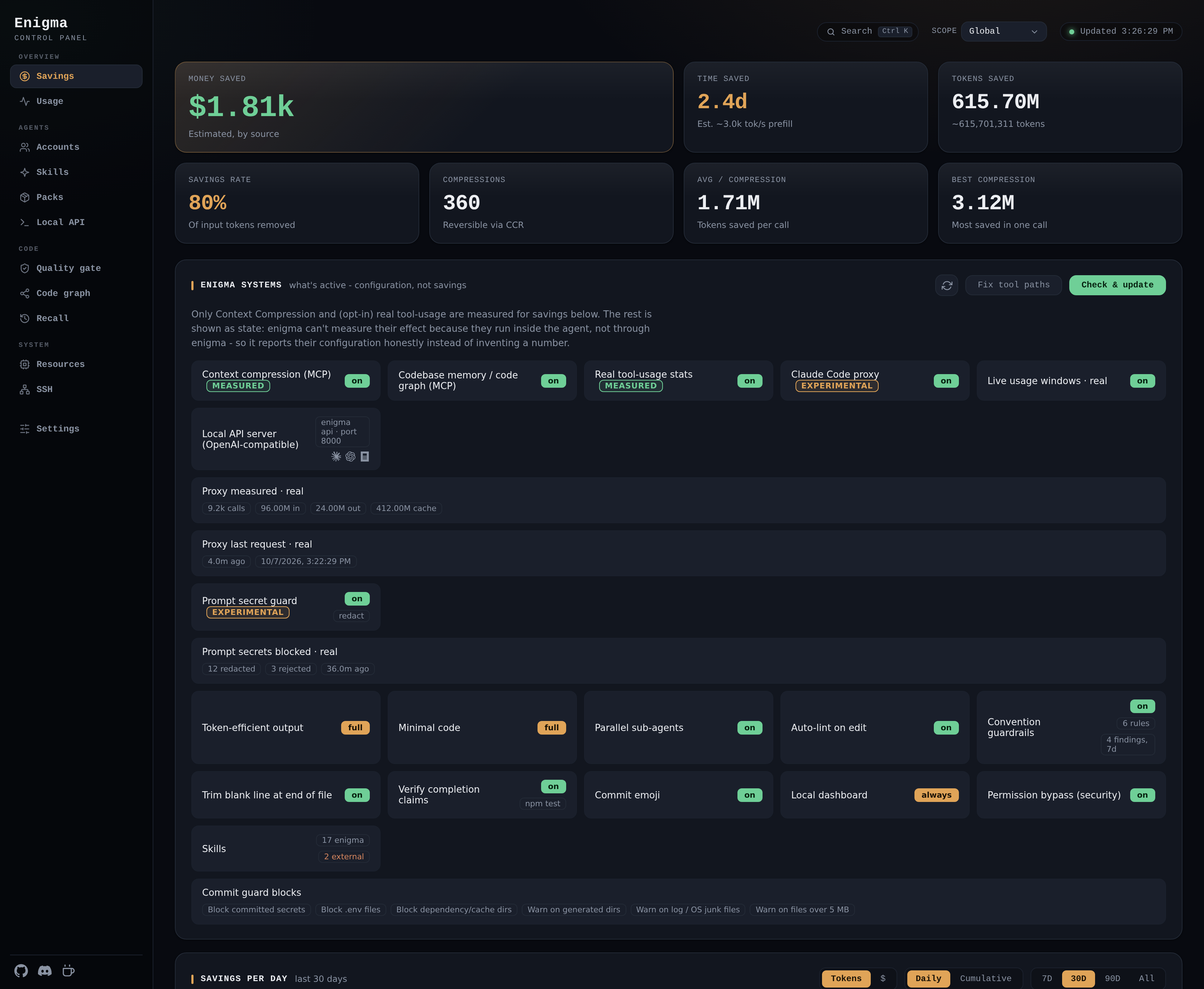
A loopback control panel for accounts, skills, settings and system cleanup, with real Claude usage and measured savings. Nothing leaves your machine.
Several logins per tool without logging out, each in its own config dir. Profiles pin one account per tool and drive every launch.
enigma design turns a live site, a project or a git repo into a DESIGN.md and a skill: palette, type scale, spacing, motion and components.
Isolated harness packs on demand: Helio for bug bounty, Orion for broken flows, speed and scale. Neither loads into your normal agent.
Learn more →enigma autoskills reads your project and installs the matching community skills for React, Next.js, Astro, Prisma, Rails and ~90 more.
enigma api serves your local agents over one OpenAI-compatible API; enigma ssh saves each server once and tunnels ports by name.
Enigma doesn't swap your model - it changes what comes out of it. The left is a coding agent on its defaults; the right is the same agent with enigma's policies, guard and output discipline.
update stuff 🤖 Generated with Claude Code Co-Authored-By: Claude <noreply@anthropic.com>
✨ feat(auth): add PKCE token refresh 🐛 fix(api): retry 429s with backoff ♻️ refactor(db): extract query builder
// EnvManager.ts export class EnvManager { private static instance: EnvManager; private cache = new Map<string, string>(); static getInstance() { if (!this.instance) this.instance = new EnvManager(); return this.instance; } get(key: string, fb?: string) { if (this.cache.has(key)) return this.cache.get(key)!; const v = process.env[key] ?? fb; if (v == undefined) throw new Error("Missing " + key); this.cache.set(key, v); return v; } }
export function env(key: string, fb?: string) { const v = process.env[key] ?? fb; if (v == null) throw new Error("Missing " + key); return v; }
$ git add .env $ git commit -m "wip" [main 4f2a1c8] wip 2 files changed, 18 insertions(+) $ git push # .env + key now public
$ git add .env $ git commit -m "wip" enigma-guard: BLOCKED - 2 problem(s): x .env [env file with secrets] x src/config.ts:12 [secret: Anthropic API key] commit aborted.
Our revolutionary, next-generation platform — engineered from the ground up — leverages cutting-edge AI to seamlessly supercharge your workflow, unlock unprecedented synergy, and deliver world-class results — and so much more.
Installs shared engineering skills into your coding agent, blocks secrets before they reach a commit, and manages everything from one local dashboard.
Sure! I'd be happy to help you with that. Let me start by taking a careful look at the existing code so I can fully understand how everything is currently structured, and then I'll go ahead and make the changes needed to address the issue you've described.
Reading the existing code, then fixing the issue.
Enigma turns off the noise and turns on the shortcuts the moment you install - so every session is faster, quieter and cheaper.
Permission bypass is on by default, so the agent stops asking before every action and just works. A deliberate security trade-off you can opt out of globally or per agent.
Claude Code's feedback survey is switched off at install, so it never interrupts you mid-flow.
Specialized policy skills (security, testing, git, style, debugging...) mean fewer wrong turns and re-prompts - which means fewer tokens and less of your time.
GitHub CLI telemetry is disabled at install (and it sidesteps a Windows console-flash bug too). Nothing phones home.
Opt-in token-efficient output and a native context-compression engine shrink prompts and tool output - the same work for fewer tokens.
The agent is kept from attributing commits to itself, so your history stays yours - nothing to undo later.
Unlike a static skill, each enigma skill adapts to the app that runs it, re-renders from your config, and loads by context - sealed, versioned, and updated straight from the repo. How Dynamic Skills work → Newest edits first.
Loading skills...
Interaction logic is behaviour, and behaviour that has already been measured and tested belongs in a package. Add it as a dependency, or copy the source in and own it. No styles of their own - the look stays yours. How components work →
A looping row that can be grabbed and thrown - logo walls, testimonial strips, pill rails. Takes a speed in px/s, never a duration, so it does not accelerate every time you add an item.
Documentation →Short-TTL read cache whose point is the in-flight deduplication: two components asking for one key make one request, not five, so a rate limit sees one.
Documentation →Ordering, dedupe by key and sticky errors, with dismiss timers that hold rather than run while the tab is hidden. Rendering stays yours.
Documentation →A local control panel for the whole thing: switch accounts and profiles, enable or edit skills per app, change any setting, and free up your machine (kill a port, shut down WSL, quit Docker). It also shows real Claude usage and the savings enigma can measure - honest by design.

| Setup task | With Enigma | By hand |
|---|---|---|
| Shared skills across Claude Code, Codex, opencode, Kimi Code | One command | Per-agent, by hand |
| Skills kept current | Auto-sync + GitHub updates | Manual re-copy |
| Per-agent skill selection | Built in | Not available |
| Commit secret/.env guard | Portable, team-shareable | Ad-hoc scripts |
| Dashboard to manage it all | Local, loopback-only | None |
| Multi-account switching | OS-agnostic, no aliases | Shell hacks |
The skills are just Markdown in the repo. Improve one and share it back, whichever way suits you - the dashboard's "Propose an improvement" button opens the exact file on GitHub.
Edit a skill's SKILL.md on GitHub and open a PR. It is reviewed, sealed and shipped to everyone.
Not sure how to change it? Open an issue describing the improvement and we will take it from there.
Bounce ideas off the community on Discord before you build.